

The ENIGMA-OCD working group was initiated by Dan Stein (Cape Town, South Africa) and Odile van den Heuvel (Amsterdam, The Netherlands) in 2013, as a next generation worldwide collaboration that started in 2010 as the OCD Brain Imaging Consortium (OBIC, with only 7 sites sharing their raw MRI scans of adults with and without OCD). With the goals of obtaining larger sample sizes than represented in OBIC, increasing worldwide coverage, extending the samples to pediatric OCD, comparing OCD to other disorders, and eventually combining imaging data and genetics, Stein and van den Heuvel proposed adding an ENIGMA-OCD working group to the ENIGMA consortium that Paul Thompson initiated in 2009. The ENIGMA-OCD working group developed into a very productive worldwide collaboration on brain imaging research in OCD, with multiple collaborators taking the leadership in specific projects (see below for the details). After the sudden passing of Dan Stein in December 2025, Chris Vriend and Kathrin Koch joined Odile van den Heuvel as new chairs of the working group.
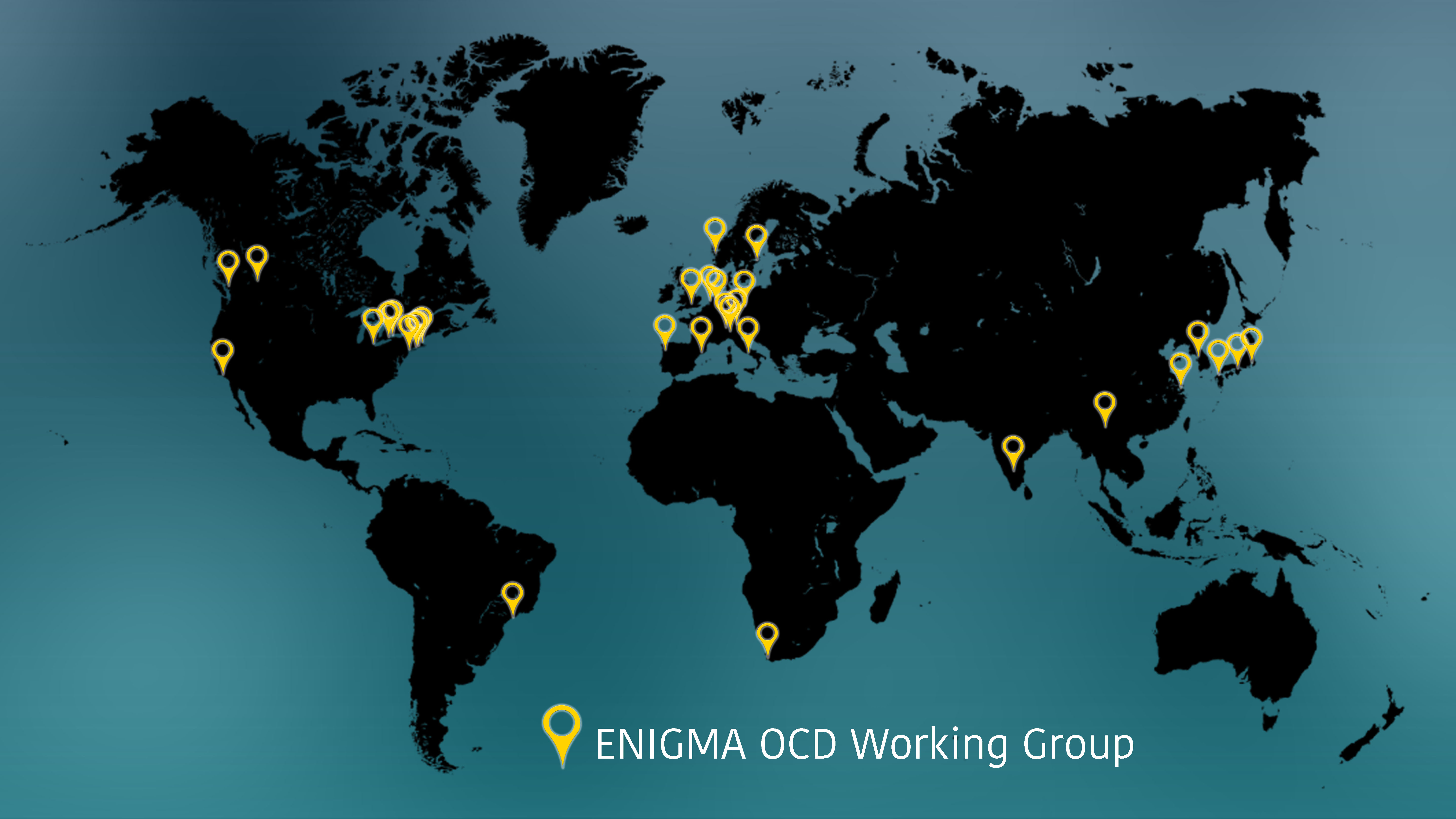
The ENIGMA-OCD WG currently consists of 65 samples from 31 institutes in 17 countries on 5 continents, with a total sample of approximately 3,000 OCD patients and about 3,000 healthy controls. Initial work has focused on studies of subcortical volume (Boedhoe et al. 2017 Am J Psych), cortical thickness (Boedhoe et al. 2018 Am J Psych), structural connectivity (Yun et al. 2020 Brain), and brain lateralization (Kong et al. 2020 Biol Psychiatry) in children, adolescents and adults with OCD, also including the study on the commonalities and distinctions across different neurodevelopment disorders (Boedhoe et al. 2020 Am J Psych). Additional work is done (and still ongoing) employing diffusion imaging (Piras et al. 2021 Transl Psych, Kim et al. 2024 Mol Psychiatry), machine learning techniques to perform classification based on resting state data, diffusion data and gray matter structural data as well as to predict therapy outcome (Bruin et al. 2020 Transl Psych, Bruin et al. 2023 Mol PsychiatryBruin et al. 2020 Transl Psych, van de Mortel et al. 2025 J Affect Disord, Kim et al. 2024 Mol Psychiatry, Pak et al. 2026). Other work focused on pathologically relevant regions such as the thalamus (Weeland et al. 2022 Transl Psychiatry), hippocampus/amygdala (Thorsen et al. 2026 Mol Psychiatry) and the cerebellum (Balachander et al. 2026 Biol. Psychiatry Cogn. Neurosci. Neuroimaging). Additional studies examined the neurobiological and transcriptomic correlates of morphological alterations, including virtual histology across psychiatric disorders (Patel et al. 2021 JAMA Psychiatry) and spatial associations with gene-expression patterns (Saraiva et al. 2026 Nat. Commun), on the investigation of disrupted higher-order functional connectivity (Ruan et al. 2026), and on the investigation of medication effects on subcortical and cortical morphology (Ivanov et al. 2022 J Affect Disord, Ivanov et al. 2026 Cortex). A further study investigated structural neuroimaging predictors of cognitive-behavioral therapy response in children and adults with OCD (Bertolín et al. 2023 J Am Acad Child Adolesc Psychiatry). Moreover, task-based fMRI analyses explored alterations in association with negative valence processing, executive processing, and inhibitory processing (Dzinalija et al. 2025, Dzinalija et al. 2025 Biol Psychiatry, Dzinalija et al. 2026 Biol Psychiatry Cogn Neurosci Neuroimaging). Methodological work using ENIGMA-OCD data has additionally compared meta- and mega-analytic approaches (Boedhoe et al. 2019 Front Neuroinform). An overview of the first 5 years of ENIGMA-OCD is recently published in the special issue on ENIGMA (van den Heuvel et al. 2020 HBM). New data pipelines are currently running, focusing on thalamus and cerebellum segmentations, voxel-based morphometry, and resting state fMRI data. Task-based fMRI analyses will be possible in the near future.
ENIGMA-OCD has brought together OCD experts from all over the world to re-analyze historical MRI data using meta- and mega-analyses. This has not only resulted in important contributions to the literature on brain alterations in OCD, but has also stimulated international collaboration and sharing of OCD imaging data from sites across the globe (e.g., the Global OCD Consortium, under the leadership of Blair Simpson, New York). There are many questions still to address in the growing ENIGMA-OCD dataset. The findings and the successful model of international collaboration have already spurred new studies.
Large-scale data-sharing as facilitated by ENIGMA-OCD has accelerated discovery and generated novel hypotheses that are now being pursued. It has also created a model for large-scale global collaboration across OCD experts, and even more broadly, across working groups focused on a range of disorders and methodologies. By joining forces, we can help to shift the research model from local and mono-disciplinary to global and multidisciplinary and increase rigor and transparency. In the end, we share a common goal: developing a circuit-based approach to different cognitive and clinical dimensions of OCD that can help transform how OCD and related mental disorders are conceptualized, diagnosed, and ultimately treated around the world.
We are happy to welcome new cohorts at any time! If you would like to receive more information and/or are willing to participate in this initiative by contributing your data to ENIGMA-OCD projects, please contact:
|
Prof. dr. Odile van den Heuvel (oa.vandenheuvel@amsterdamumc.nl)  |
Prof. dr. Kathrin Koch  |
dr. Chris Vriend  |
- ENIGMA OCD MOU guidelines to participate
- ENIGMA OCD list of participating groups
- ENIGMA OCD members page (password-protected)
Projects and their status
Published
Subcortical Volume
Premika Boedhoe and Odile van den Heuvel (Amsterdam, The Netherlands) — “Distinct Subcortical Volume Alterations in Pediatric and Adult OCD: A Worldwide Meta- and Mega-Analysis”, American Journal of Psychiatry, 2017
Cortical Thickness & Surface Area
Premika Boedhoe and Odile van den Heuvel (Amsterdam, The Netherlands) — “Cortical Abnormalities Associated With Pediatric and Adult Obsessive-Compulsive Disorder: Findings From the ENIGMA Obsessive-Compulsive Disorder Working Group”, American Journal of Psychiatry, 2018
Meta vs. Mega Analysis Methods
Premika Boedhoe, Odile van den Heuvel and Jos Twisk (Amsterdam, The Netherlands) — “An Empirical Comparison of Meta- and Mega-Analysis With Data From the ENIGMA Obsessive-Compulsive Disorder Working Group”, Frontiers in Neuroinformatics, 2019
Structural Covariance
Je-Yeon Yun and Jun Soo Kwon (Seoul, South Korea) — “Brain Structural Covariance Networks in Obsessive-Compulsive Disorder: A Graph Analysis from the ENIGMA Consortium”, Brain, 2020
Structural Lateralization
Xiang-Zhen Kong and Clyde Francks (Nijmegen, The Netherlands) — “Mapping Cortical and Subcortical Asymmetry in Obsessive-Compulsive Disorder: Findings From the ENIGMA Consortium”, Biological Psychiatry, 2020
Cross-Disorder ASD, ADHD & OCD
Premika Boedhoe and Odile van den Heuvel, OCD Working Group (Amsterdam, The Netherlands); Daan van Rooij and Jan Buitelaar, ASD Working Group; Martine Hoogman and Barbara Franke, ADHD Working Group (Nijmegen, The Netherlands) — “Subcortical Brain Volume, Regional Cortical Thickness, and Cortical Surface Area Across Disorders: Findings From the ENIGMA ADHD, ASD, and OCD Working Groups”, American Journal of Psychiatry, 2020
Machine Learning
Willem B. Bruin, Jonathan Shock, Dan Stein and Guido van Wingen (Amsterdam, The Netherlands) — “Machine Learning Benchmarks for the Classification of OCD", Translational Psychiatry, 2020
Virtual Histology
Yash Patel and Tomas Paus (Toronto, Canada) — “Virtual Histology of Cortical Thickness and Shared Neurobiology in 6 Psychiatric Disorders", JAMA Psychiatry, 2021
Diffusion Imaging
Fabrizio Piras and Gianfranco Spalletta (Rome, Italy) — “White Matter Microstructure and its Relation to Clinical Features of Obsessive-Compulsive Disorder: Findings from the ENIGMA OCD Working Group", Translational Psychiatry, 2021
Medication Effects on Subcortical Morphology
Iliyan Ivanov and collaborators — “Associations of Medication with Subcortical Morphology Across the Lifespan in OCD: Results from the International ENIGMA Consortium", Journal of Affective Disorders, 2022
Thalamic Segmentation
Chris Vriend, Niels de Joode, Selina Kasprzak and Odile van den Heuvel (Amsterdam, The Netherlands) — “The Thalamus and its Subnuclei—a Gateway to Obsessive-Compulsive Disorder", Translational Psychiatry, 2022
Functional Connectomics
Willem B. Bruin and Guido van Wingen (Amsterdam, The Netherlands) — “The Functional Connectome in Obsessive-Compulsive Disorder: Resting-State Mega-Analysis and Machine Learning Classification for the ENIGMA-OCD Consortium", Molecular Psychiatry, 2023
CBT response in children
Sara Bertolín and Carles Soriano-Mas (Barcelona, Spain) - "Right Prefrontal Cortical Thickness Is Associated With Response to Cognitive-Behavioral Therapy in Children With Obsessive-Compulsive Disorder”, Journal of the American Academy of Child & Adolescent Psychiatry, 2023
Diffusion Imaging & Machine Learning
Minah Kim, Jiook Cha and collaborators (Seoul, South Korea) — “White Matter Diffusion Estimates in Obsessive-Compulsive Disorder Across 1653 Individuals: Machine Learning Findings from the ENIGMA OCD Working Group", Molecular Psychiatry, 2024
Task-Based fMRI: Negative Valence Processing
Nadža Džinalija, Chris Vriend and collaborators (Amsterdam, The Netherlands) — “Negative Valence in Obsessive-Compulsive Disorder: A Worldwide Mega-Analysis of Task-Based Functional Neuroimaging Data of the ENIGMA-OCD Consortium", Biological Psychiatry, 2025
CBT Outcome Prediction
Laurens A. van de Mortel, Willem B. Bruin, Guido van Wingen and collaborators (Amsterdam, The Netherlands) — “Development and Validation of a Machine Learning Model to Predict Cognitive Behavioral Therapy Outcome in Obsessive-Compulsive Disorder Using Clinical and Neuroimaging Data”, Journal of Affective Disorders, 2025
Task-Based fMRI: Inhibitory Processing
Nadža Džinalija, Chris Vriend, Ilya Veer and Odile van den Heuvel (Amsterdam, The Netherlands) — “"Inhibitory Control and Error Processing in Obsessive-Compulsive Disorder: A Mega-Analysis of Task-Based fMRI Data by the ENIGMA-OCD Consortium", Biological Psychiatry: Cognitive Neuroscience and Neuroimaging, 2026
Gray/White Matter Contrast
Anders Lillevik Thorsen, Vilde Brecke and Olga Therese Ousdal (Bergen, Norway) — “Altered Frontal and Occipital Cortical Microstructure in Obsessive-Compulsive Disorder – A Multisite Mega-Analysis”, Molecular Psychiatry, 2026
Cerebellum volume
Srinivas Balachander, Janardhanan C. Narayanaswamy, Ganesan Venkatasubramanian and Y. C. Janardhan Reddy (Bengaluru, India) — “Regional Cerebellar Volumetrics in Obsessive-Compulsive Disorder: An ENIGMA-OCD Study”, Biological Psychiatry: Cognitive Neuroscience and Neuroimaging, 2026
Task-Based fMRI: Executive Function
Nadža Džinalija, Ilya Veer, Chris Vriend, Odile van den Heuvel and collaborators (Amsterdam, The Netherlands) — “Executive Function in Obsessive-Compulsive Disorder: A Worldwide Mega-Analysis of Task-Based Functional Neuroimaging Data of the ENIGMA-OCD Consortium”, Biological Psychiatry: Cognitive Neuroscience and Neuroimaging, 2026
Transcriptomics
Leonardo Cardoso Saraiva, João R. Sato, Carolina Cappi and collaborators (Sao Paolo, Brazil | New Haven / New Brunswick, USA) — “Regional, Functional and Transcriptomic Decoding of Multidimensional Brain Structure Alterations in Obsessive-Compulsive Disorder”, Nature Communications, 2026
Medication Effects on Cortical Morphology
Joseph O’Neil, Iliyan Ivanov and collaborators (New York, USA) — „Distribution and age-interactions of cortical thickness associated with specific classes of medication used to treat obsessive-compulsive disorder: Results from the international ENIGMA Consortium”, Cortex, 2026.
Amygdala/Hippocampus Subsegmentation
Vilde Brecke, Anders Thorsen and Olga Therese Ousdal and collaborators (Bergen, Norway) — “Total and subregional amygdalar and hippocampal volumes across the lifespan in obsessive-compulsive disorder: findings from the ENIGMA-OCD working group”, Molecular Psychiatry, 2026
Ongoing projects
Voxel-Based Morphometry
Matthew Kempton, Anthony James and Odile van den Heuvel (London, United Kingdom; Amsterdam, The Netherlands) — “"ENIGMA Voxel Based Morphometry Meta-Analysis of Regional Brain Volume in Patients with OCD"“
SuStaIn
Ying Zhao, Hailun, Di Chen, Valerie Voon and Jianfeng Feng (Cambridge, United Kingdom; Shanghai, China) — “"Distinct Neuroimaging Subtype Trajectories in Obsessive-Compulsive Disorder"
Biotypes
Xi Zhu, Rachel Marsh and Blair Simpson (New York, NY, United States) — “"Identifying Biotypes of Obsessive-Compulsive Disorder Using Deep Learning"
Gyrification
Inkyung Park and Jun Soo Kwon (Seoul, South Korea) — “"Cortical Gyrification Differences Between Early- and Late-Onset OCD: Evidence for Neurodevelopmentally Distinct Subgroups"
Task-Based fMRI: CBT Outcome Prediction
Nadža Džinalija and collaborators (Amsterdam, The Netherlands) — “"Predicting Cognitive-Behavioral Therapy Outcomes in Obsessive-Compulsive Disorder from Inhibitory Control Neural Activity: A Mega-Analysis and Machine Learning Study from the ENIGMA-OCD Consortium"
Deep Learning of Spatiotemporal Functional Data in Resting-State fMRI
Sang-Yoon Bae, Willem B. Bruin, Guido van Wingen and Jiook Cha (Seoul, South Korea; Amsterdam, The Netherlands) — “"Deep Learning of Spatiotemporal Functional Data in ENIGMA-OCD Resting-State fMRI"
Scalable Deep Learning
Ji-Hwan Park and Jiook Cha (Upton, NY, United States; New York, NY, United States) — “"Scalable Deep Learning Analytics to ENIGMA OCD Imaging Data to Classify OCD"
Higher-Order Functional Connectivity
Hanyang Ruan and Kathrin Koch (Munich, Germany) — “"Disrupted Higher-Order Topology in OCD Brain Networks Revealed by Hodge Laplacian – an ENIGMA Study"
Transdiagnostic Gradients Across the Lifespan
Meike Hettwer, Matthias Kirschner and Sofie Valk (Leipzig, Germany; Jülich, Germany; Geneva, Switzerland) — “"Cross Diagnostic Gradients Across the Lifespan"
Polygenic Risk Score
Shareefa Dalvie and Dan Stein (Cape Town, South Africa) — “"Polygenic Risk Score, Cortical Thickness, Surface Area and Subcortical Volumes in OCD"
Longitudinal Treatment Effects — Ignacio Martínez-Zalacaín and Carles Soriano-Mas (Barcelona, Spain) “"Brain Morphometry and Cognitive-Behavioral Therapy (CBT) in OCD: Prediction of CBT Response from Pre-Treatment Scans and Longitudinal Assessment of Morphometric Changes Induced by CBT"
Cross-Disorder OCD–Anxiety Analysis
Yafeng Zhan, Shaoling Zhao, Trevor W. Robbins and Zheng Wang (Shanghai, China; Cambridge, United Kingdom) — “ “Cross-disorder investigation of brain alterations in OCD and anxiety”
Cross-Disorder Symptom–Brain Structural Associations
Delin Sun (Durham, NC, United States) — “"ENIGMA Cross-Disorder Proposal: Symptom-Brain Structural Associations"
Cross-Disorder Subcortical Shape Analysis
Yanghee Im, Christopher Ching and Paul Thompson (Marina del Rey, CA, United States) — “"Identifying Surface-Based Subcortical Brain Alterations Across Disorders"
Cross-Disorder OCD–GAD Mega-Analysis
Luke Norman and Daniel Pine (Bethesda, Maryland, United States) — “"Cross-Disorder Comparison of Brain Structure and Resting-State Functional Connectivity Between OCD and GAD: An ENIGMA Mega-Analysis"
Neurospectrum-Based Geometric and Topological Phenoscaping and Prediction in OCD
Smita Krishnaswamy and collaborators (New Haven, CT, United States) — “"Neurospectrum-Based Geometric and Topological Phenoscaping and Predictions for OCD"
Structural connectome in OCD
Chris Vriend, Niels de Joode, Odile van den Heuvel and collaborators (Amsterdam, The Netherlands)
Dynamic functional connectivity in OCD
Yange Chang, Hanyang Ruan, Kathrin Koch (Munich, Germany) - “Mapping altered brain-state transitions in obsessive-compulsive disorder using co-activation patterns and network control theory”
Publications
- Cortical Thickness & Surface Area
Boedhoe et al. (2018). "Cortical abnormalities associated with pediatric and adult obsessive-compulsive disorder: findings from the ENIGMA Obsessive-Compulsive Disorder Working Group." American Journal of Psychiatry 175(5), 453–462. DOI: 10.1176/appi.ajp.2017.17050485
- Meta vs. Mega Analysis Methods
Boedhoe et al. (2019). "An empirical comparison of meta- and mega-analysis with data from the ENIGMA obsessive-compulsive disorder working group." Frontiers in Neuroinformatics 12, 102. DOI: 10.3389/fninf.2018.00102
- An Overview of the First 5 Years of ENIGMA OCD
van den Heuvel et al. (2020). "An overview of the first 5 years of the ENIGMA obsessive–compulsive disorder working group: The power of worldwide collaboration." Human Brain Mapping. DOI: 10.1002/hbm.24972
- Structural Covariance
Yun et al. (2020). "Brain structural covariance networks in obsessive-compulsive disorder: a graph analysis from the ENIGMA Consortium." Brain 143(2), 684–700. DOI: 10.1093/brain/awaa001
- White Matter Miscrostructure
Piras et al. (2021). "Structural neuroimaging biomarkers for obsessive-compulsive disorder in the ENIGMA-OCD consortium: medication matters." Translational Psychiatry 10, 342. DOI: 10.1038/s41398-020-01013-y
- Thalamic Segmentation
Weeland et al. (2022). "The thalamus and its subnuclei — a gateway to obsessive-compulsive disorder." Translational Psychiatry 12(1), 70. DOI: 10.1038/s41398-022-01823-2
- Medication Effects on Subcortical Morphology
Ivanov et al. (2022). "Associations of medication with subcortical morphology across the lifespan in OCD: Results from the international ENIGMA Consortium." Journal of Affective Disorders 318, 204–216. DOI: 10.1016/j.jad.2022.08.084
- Functional Connectomics
Bruin et al. (2023). "The functional connectome in obsessive-compulsive disorder: resting-state mega-analysis and machine learning classification for the ENIGMA-OCD consortium." Molecular Psychiatry 28, 4307–4319. DOI: 10.1038/s41380-023-02077-0 (Correction: 10.1038/s41380-023-02211-y)
- Diffusion Imaging & Machine Learning
Kim et al. (2024). "White matter diffusion estimates in obsessive-compulsive disorder across 1653 individuals: machine learning findings from the ENIGMA OCD Working Group." Molecular Psychiatry. DOI: 10.1038/s41380-023-02392-6 (Correction: 10.1038/s41380-024-02494-9)
- Task-Based fMRI: Negative Valence Processing
Dzinalija et al. (2025). "Negative Valence in Obsessive-Compulsive Disorder: A Worldwide Mega-Analysis of Task-Based Functional Neuroimaging Data of the ENIGMA-OCD Consortium." Biological Psychiatry 98(3), 219–229. DOI: 10.1016/j.biopsych.2024.12.011
- Task-Based fMRI: Inhibitory Control
Dzinalija et al. (2026). "Inhibitory control and error processing in Obsessive-Compulsive Disorder: A mega-analysis of task-based fMRI data by the ENIGMA-OCD consortium." Biological Psychiatry: Cognitive Neuroscience and Neuroimaging. DOI: 10.1016/j.bpsc.2026.02.006 (Published version of the bioRxiv preprint below.)
- Task-Based fMRI: Executive Function
Dzinalija et al. (2026). "Executive Function in Obsessive-Compulsive Disorder: A Worldwide Mega-Analysis of Task-Based Functional Neuroimaging Data of the ENIGMA-OCD Consortium." Biological Psychiatry: Cognitive Neuroscience and Neuroimaging 11(6), 749–759. DOI: 10.1016/j.bpsc.2026.02.007 (Published version of the bioRxiv preprint below.)
- Gray/White Matter Contrast
Thorsen et al. (2026). "Altered frontal and occipital cortical microstructure in obsessive-compulsive disorder - a multisite mega-analysis." Molecular Psychiatry 31, 4074–4082. DOI: 10.1038/s41380-026-03500-y
- Medication Effects on Cortical Morphology
Ivanov et al. (2026). " Distribution and age-interactions of cortical thickness associated with specific classes of medication used to treat obsessive-compulsive disorder: Results from the international ENIGMA Consortium." Cortex, in press. DOI: 10.1016/j.cortex.2026.08.015
Preprints